College Ready

Sharing strategies for student success, college readiness and academic coaching


1 Comment

At Semester’s End: Closing Thoughts from an English Prof

Keep Moving Forward.

As a college instructor, beginnings and endings are an integral part of my life. Each semester, I meet a new group of students, in each of my classes, and we get to know each other. We connect and we learn each others’ stories, if you will. 18 weeks later, we part ways, having shared the classroom experience. Although I occasionally have a student for another semester, for the most part I won’t see many of them again. Our time together is brief but significant.

I believe that the way you begin a semester is absolutely critical. From day 1, you’re teaching and you’re leading and you’re setting the tone. But on the flip side of that, I believe that endings are equally crucial. One part of their journey may be over, a class checked off a list of requirements, but the next steps are still to be taken, and the finish line of graduation, still a long way off. By ending on the right tone, you set your students up for taking that next step. You set them up to keep moving forward.

For a sense of closure and to mark the end of the semester, I always have a class party, in the form of a potluck and a mega-trivia challenge, based on the course content. These are celebrations of all the hard work, critical thinking, sharing of ideas and ok, blood, sweat and tears, that students have put into their writing and learning for those 18 weeks. These parties are so much fun. Students bring in all sorts of amazing delicacies, and this semester, one of my students even brought in homemade tamales-cooked by none other than his abuela–for the entire class. Another student made 2 different types of cake pops, while another did a homemade pie…we are never lacking sweet treats at these shindigs! Far more important than the food though, these gestures show the students that they have meant something to each other, and the connections made have been important.

I also write a “Final Thought” blog post, to reflect on the semester and wish my students well as they continue on their path towards their academic goals. I specifically tell them “Don’t ever give up.” Students do need to hear that message, early and often, during their college careers. So much of student success comes from resilience, grit, and a belief that it is possible. As instructors, we are teachers. But, we are also role models, mentors and messengers, and when we believe in them, students start to have a stronger belief in themselves. Here’s this year’s post, called On Endings, Broad Margins, and Moving Forward.

How about you? What do you do to mark the end of a semester or school year? Do you have certain traditions or rituals that help you to wind down, say goodbye, and move ahead in a positive way? I’d love to hear from you.

All the best for a restful Winter Break~

Lisa xo


Leave a comment

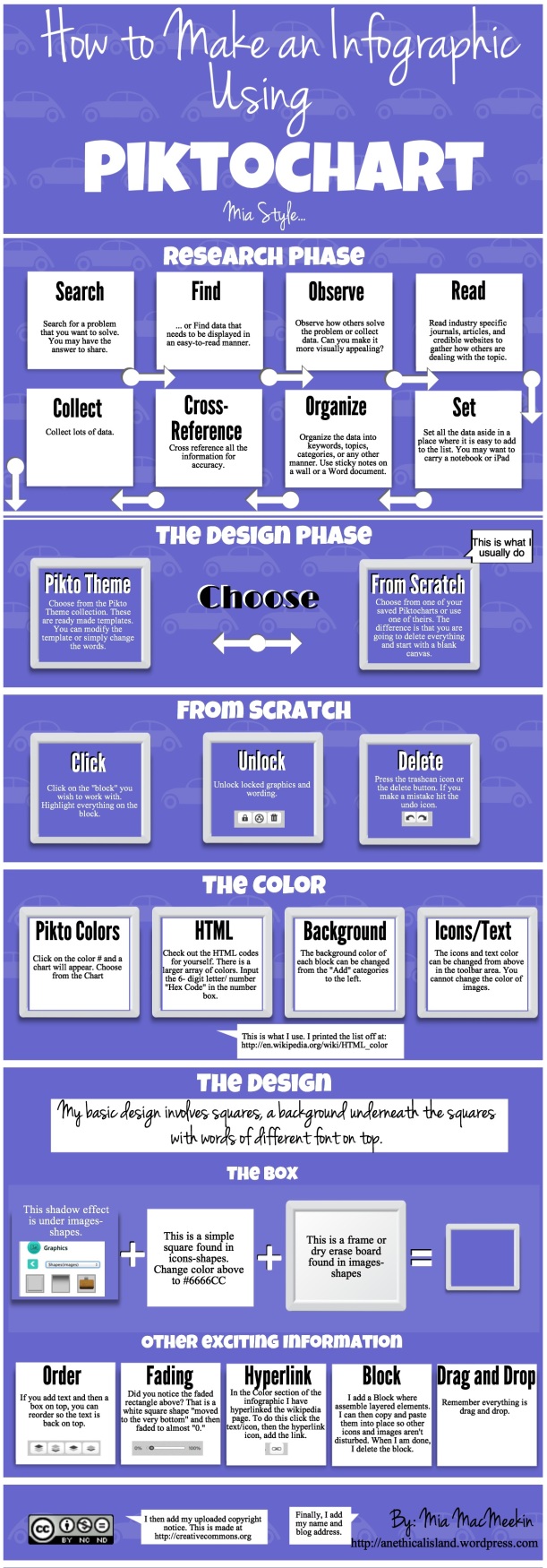
Tutorial: How to Make an Infographic using Piktochart.

This is an amazing tutorial, with step-by-step instructions, on “How to Make an Infographic” using Piktochart, by Mia MacMeekin. I always find her infographics engaging and easy to follow, so I was excited that she did this tutorial and thought it was worth sharing. Like she says, she finds them “simple” to do , but simple often means “hundreds of hours playing w Piktochart.” Still, it’s a skill all 21st educators are going to want to add to their toolbox…so here it is. Enjoy.

Mia's avatarAn Ethical Island

Hello, World!

Lots of my friends have been asking me how I make the infographics. I find it very simple. But, I admit that that simple mindset is after hundreds of hours playing with Piktochart. I think I know most of the quirks. Well that was I did until last week when Piktochart updated the website. BUT, I am getting used to the new platform and love it!

Here is a quick overview of how I make them…

How to Make a Piktochart infogrpahic

~Mia

View original post


Leave a comment

5 Ways a College Degree Pays: a richer life in all respects!

Video: “5 Ways Ed Pays.” A college degree means a richer life-not just in terms of money earned, but in quality of life! Get inspired. Be inspirational. Every student deserves a teacher who inspires! Just be open to good things, and be yourself…that will do! 


Do you agree that a college degree means a richer life? Post a comment and join the discussion! We’d love to hear from you!


Leave a comment

Wanted: Happy Teachers

For all the amazing educators who help make the world happy! It’s about that “Back-to-School” time around here and…

collegereadycoach.com

The energy we bring to the classroom makes a profound difference on our students and their learning outcomes. The brain “at positive” is 31% more productive than at negative, neutral, or stressed.

What can you do to be a Happy Teacher? I write, share ideas with colleagues, and mentor as ways to stay focused. I also employ “playful learning” strategies, because a place of learning needs to be welcoming and inspiring. Oh, and don’t forget to smile, laugh, and share a little bit about yourself with your students.

How about you? Can you share one idea in the comments for being a “Happy Teacher?” Post your suggestions, tips, and hints here, please. Merci!

On Teaching a Love of Reading.

Leave a comment

On Teaching a Love of Reading.

“We shouldn’t teach great books; we should teach a love of reading.” B. F. Skinner

This is my truth…always has been. Always will be.

AND, it’s why my son, in 2nd grade, read the entire Captain Underpants series. Even though the school library wouldn’t stock the books, (something about the word booger and/or atomic wedgie in every title, I guess). Even with a mom with an MA in American Literature. Yep. I encouraged him. Heck, I even bought ’em for him!

Because when you want to read…when you love to read…when you can’t wait to turn that next page to see what comes next…You Read.

And that’s all that matters, in the end. The reading.

B.F. Skinner had it right!

           Teach a love of Reading.

                  Amen & hallelujah.

Oh, and PS: Full disclosure–I had to look up the correct spelling of “booger.” Guess it’s been too long since I have read a Dav Pilkey EPIC novel! 🙂

So, tell us…how do you make sure your students or your children want to read? Are there books they would read again and again? Books they love but you hate? We’d love to hear from you in the comments. 

Sept. 2014 Postscript since this post was originally published: Dav Pilkey’s Captain Underpants series has claimed the top spot on the Most Frequently Banned Books list for two years in a row, 2012 and 2013. All the more reason to live dangerously…read!

Feel free to follow me here, or on Facebook, Tumblr or Pinterest, for more short but sweet posts, freebies, teaching ideas and fun images about literacy, reading and education, with a side serving of inspiration. Because we could all use a little more inspiration. Right? Right!


Leave a comment

Wise Words: Be You

Image


2 Comments

5 Ways to Have a GOOD Mornin’

Improve your Morning! Hint, just add coffee. Problem solved, right?! Ha!

Ok, we all know the benefits of the mornin’ cup o’ joe! Here are some suggestions beyond coffee to add to the mix:

College Prep

One of my go-to ways to improve my morning is by waking up earlier than everyone else in the house.  It is so quiet and peaceful. So mornings, it even gives me the chance to watch the sunrise while I drink my coffee.

That quiet time–whether it’s 30 minutes, or even 5–really gives me the opportunity to get focused for the day. I end up feeling relaxed and ready to tackle the challenges of the morning routine–whether it’s prepping kid lunches, hectic school drop-offs, or taming an unwieldy stack of essays that need grading!

Is your a.m. routine listed here, or do you have some other suggestions for making the most of your morning? What helps you wake up with a smile on your face?


Leave a comment

Weekend Wise Words: Think Outside

It’s Friday. Time to unplug and recharge.

Hope you’re able to enjoy some time outside this weekend.

Thinking: Optional.    Relaxing: Mandatory.

Image

There are a lot of amazing hiking trails nearby where I go to reconnect and recharge. The great outdoors requires very little of us, other than showing up. I feel a little lighter and stay in the moment a little longer when I’m among the trees & sunshine.

How about you? Does nature help you feel replenished & refreshed? What’s your favorite way to recharge on the weekends?


Leave a comment

College Students: Dream Big

BE YOU

Are you heading back to campus soon?

Whether you’re a student or a teacher: Dream Big!

Connect ~ Inspire ~ Learn ~ Grow!

wordle college ready final

“Hold Fast to Dreams, for if Dreams Die, Life is a Broken-Winged Bird that Cannot Fly.” Langston Hughes


1 Comment

Keep it REAL–4 Easy Steps to Determine Source Credibility

The problem: Not all sources are created equal.

The solution: Keep it REAL–4 Easy Steps to credible & authentic source material.

When it comes time to do research, most of us (not *just our students),  reach for our phones and just “Google it.”

Yet, when it comes time to incorporate source content into their writing, we want students to go beyond that one easy step. Our students have an enormous amount of  information at their fingertips. And therein lies the difficulty. They literally carry around so much data in their smartphones, it’s enough to make a grad student’s head spin, let alone a frosh college student, or the high school set.

As we know though, all internet sources are NOT created equal. From paid links, to content farms and the like–what steps can students-and the rest of us–take to analyze a source for credibility? By using this handy chart with the mnemonic REAL , they will be able to sort through a lot of the “junk” that’s available and find a nugget of REAL, and credible information.

786e5cd6bd2669ffe2e57208cf994972[1]

The four quick and easy steps are: Read the URL. Examine Content. Ask about the Author. Look at the Links.

Use an in-class discussion to educate students on the importance of each of these four categories, using the chart as a guide while you talk. Have a variety of articles related to the same topic, but from different websites, ready to look at on your smartboard, so students have a visual for the type of comparisons and analysis that is involved.

There are other approaches to this question of source credibility. However, I’d rather give my students a quick and easy tool that they are likely to actually remember and use, then a long, pragmatic list of filters and variables that will cause their eyes to gloss over.

So, when it comes to source credibility, let’s help our students keep it REAL. What do you think–is this an approach that would work in your classroom? Or in your own professional writing? If you’re a student, would this method help you? I’d love to hear from you!